

1. The development trend of electric commercial vehicles
Commercial vehicles are comprehensively undergoing electrification transformation. High-voltage cab equipment has become a standard feature for vehicle production. These on-board devices require stable, safe and reliable DC power conversion equipment to support long-term and high-intensity outdoor working conditions.
2. Current pain points of existing products in the industry
Outdoor workers in commercial environments have strict requirements for electrical protection. The Full Protection Automotive DC-DC Converter can prevent the chain reaction of faults from the source, ensuring the stable and safe operation of the entire vehicle's electronic control system.
In the current market, the majority of ordinary non-isolated DCDC controllers are only suitable for light civilian equipment. When used in commercial vehicle conditions, they will expose a series of high-voltage safety hazards, CAN bus communication interference, short equipment service life and other defects. An inappropriate power conversion solution will cause frequent system failures of the entire vehicle, increase the later maintenance costs, and at the same time fail to meet the requirements of vehicle electrical safety standards.
3. Criteria for Selecting Isolated DC-DC Core for Commercial Vehicles
Equipment manufacturers are all seeking dedicated DC-DC solutions suitable for commercial vehicle operating conditions. The core issue that everyone is most concerned about remains unchanged: Which DC-DC controllers are compatible with commercial vehicles? In fact, in the industry, the isolated DC-DC converter for commercial vehicles is the mainstream compliant equipment that meets the selection requirements of commercial vehicle OEMs.
To evaluate the quality of the isolated DC-DC controllers for commercial vehicle body equipment, the following four core standards are mainly considered: complete electrical isolation structure, IP67 environmental protection rating, liquid cooling heat dissipation architecture, and standard CAN2.0 on-board communication interface.
The above design standards can ensure the high-voltage safety of the entire vehicle and its stable operation over a long period of time, and they are also fully compatible with the electronic control systems of commercial vehicles.
Analysis of the four core technical indicators:
(1)Isolated electrical architecture
A strict high-low voltage isolation design is adopted, completely separating the 48V low-voltage chassis circuit from the 200-400V high-voltage upper-mounted circuit. This structure can avoid problems such as high-voltage breakdown and current backflow caused by common ground potential difference, complies with the high-voltage electrical safety standards for commercial vehicles, and avoids a series of potential safety hazards that may arise in the vehicle's electrical system.
(2)IP67 Dust and Water Resistance Protection
Commercial vehicles operate in harsh conditions such as mud, water, rain, snow, and dust all year round. The IP67 protection level can withstand short-term water immersion and full-range dust intrusion, ensuring the stable operation of the equipment under severe conditions and preventing hardware damage caused by environmental factors.
(3)Liquid Cooling Cooling Solution
The on-board equipment of commercial vehicles operates continuously for a long time each day. Compared with traditional cooling methods, using a cooling solution consisting of 50% water and ethylene glycol can ensure uniform and efficient heat dissipation, suppress the temperature rise of the equipment under long-term heavy-load conditions, and be suitable for all-weather continuous operation scenarios.
(4)CAN2.0 Vehicle Communication
This product is equipped with CAN2.0 communication technology, enabling real-time interaction of voltage, current, temperature, and fault information. It supports intelligent power scheduling for the entire vehicle and self-diagnosis of faults, meeting the intelligent control requirements of modern commercial vehicle electronic architectures.
Core pain points of the non-isolation solution:
Comparison of working conditions between isolation and non-isolation solutions:
| Comparison Dimension | Isolated DCDC (Automotive Grade) | Non-Isolated DCDC (Standard Model) | Project Impact |
| Safety & Compliance |
Complete isolation between high and low voltage, compliant with vehicle-level safety certification
|
Common ground loop, with risk of high-voltage breakdown | Non-isolated products are not recommended for mass production projects of commercial vehicles |
| Communication Performance | No bus signal interference |
High-frequency noise interferes with CAN bus, causing frequent equipment failures
|
Non-isolated solutions will directly affect the operational reliability of vehicles |
| Fault Risk |
Single-point fault only causes local disconnection, without affecting other modules
|
Local abnormalities are easily transmitted to the electronic control components of the entire vehicle | The frequency of replacement of after-sales parts for vehicles will increase |
4. Core advantages of the WISEDRV isolated DCDC controller
· Product Parameter Table
| Item | Description | Parameter Specification |
| Electrical Input | Input Voltage Range | 40~58Vdc, rated 48Vdc |
| Electrical Output | Output Voltage Range | 200~400Vdc |
| Electrical Output | Output Current | Max 25A |
| Control Voltage | System Control Voltage | 12Vdc |
| Communication Configuration | Vehicle Communication | CAN2.0, baud rate 500kbps |
| Heat Dissipation Solution | Cooling Method | Liquid cooling (50% water + ethylene glycol mixture), water flow rate 12-15L/min |
| Environmental Protection | Protection Class | IP67 |
· Application Scenario
DCDC Controller for Vehicle Body Systems in Commercial Vehicles
· Core technical advantages of the product
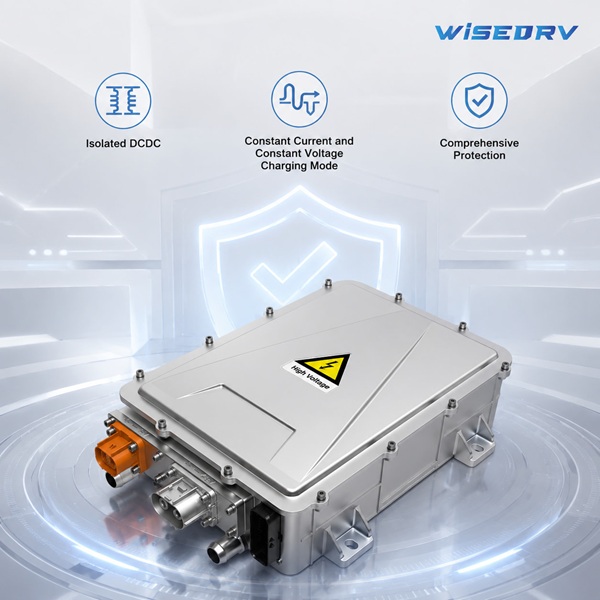
As a mature high voltage DC-DC converter for automobiles, this 48V to high voltage DCDC converter adopts an independent isolated design, equipped with a constant current and constant voltage charging mode and a complete protection mechanism. The liquid-cooled IP67 body is combined with CAN communication, and is suitable for the cab system scenarios of commercial vehicles.
5. Core Criteria for Selecting the Right Solution to Avoid Pitfalls
- It is strictly prohibited to omit the isolation architecture in order to control costs.
The non-isolation structure has a series of hidden dangers and cannot pass the commercial vehicle safety certification. Therefore, the isolation DCDC solution should be selected to avoid risks at the root.
- It is recommended to standardize the vehicle-wide CAN communication protocol.
This will enable data exchange throughout the vehicle, facilitating unified scheduling and real-time reporting of faults, and saving costs for later modifications and debugging.
- Equipped with multiple layers of comprehensive protection mechanisms.
Covering all scenarios of faults such as overvoltage, overcurrent, overheating, and short circuit, it automatically locks the output when an abnormality occurs, reducing the rate of after-sales faults.
6. FAQ
Q1: What are the core differences between isolated and non-isolated DC-DC?
The core difference between the two lies in the electrical isolation structure. In isolated products, the high and low voltage circuits are independent of each other, eliminating the risk of interlock failures and having excellent anti-interference performance; non-isolated products are prone to cause safety accidents and communication failures, and are not suitable for mass production projects of commercial vehicles.
Q2: Which commercial vehicles can the WISEDRV 48V to 320V isolated DCDC adapter be applied to?
This product is widely compatible with new energy dedicated commercial vehicles and can be matched with the high-voltage power supply scenarios of mainstream body systems.
Q3: Compared with non-isolated DCDC products on the market, what advantages does the WISEDRV controller have?
Our products are based on isolated DCDC as the core component, eliminating potential safety hazards at the source. At the same time, it is equipped with the native constant current and constant voltage charging mode and a complete multi-layer protection mechanism. The synergy of these three core configurations is an integrated advantage that cannot be achieved by a single functional module.
7. Further communication with WISEDRV
If our commercial vehicle isolation DCDC solution meets your project requirements, please click here to view the complete technical manual of the 48V to 320V on-board DCDC controller platform, which includes all parameter tables, heat dissipation specifications and performance test reports.
If you need to inquire about customized solutions, sample testing or bulk quotations, please send the detailed vehicle project information to the official email: wisedrv@wiseelec.cn.
You can also directly submit your technical requirements by going to the Contact Us page. We offer one-on-one technical personnel who will quickly assess and provide customized support for you.